
Spring Boot AOP: Part 1 - Introduction to Aspect-Oriented Programming
Understanding the problem
Imagine you’re building a banking app, and everything starts simple. You have a clean TransferService with a transfer() method that only handles the money movement. It looks nice, easy to read, and focused.
@Service
public class TransferService {
    public void transfer(Account from, Account to, BigDecimal amount) {
        from.debit(amount);
        to.credit(amount);
        accountRepository.save(from, to);
    }
}
But then things slowly get complicated.
Your manager comes and says, “Hey, we need to log every transfer.”
Okay, fine, you add some logging.
Then the security team says, “We need to know who is doing the transfer.”
So you add an authentication or permission check.
Then the auditing team says, “Please record every action in the audit table.”
More code gets added.
Now your once clean method starts getting filled with a lot of extra things that have nothing to do with the real money transfer (business logic). The actual business logic: debit, credit, save becomes only a tiny part of a bigger mess. Everything else around it is just noise that keeps growing.
Here is how it slowly turns into something messy:
@Service
public class TransferService {
    public void transfer(Account from, Account to, BigDecimal amount) {
        // Logging
        logger.info("Transfer started: {} -> {}", from.getId(), to.getId());

        // Security check
        if (!securityService.hasPermission(getCurrentUser(), "TRANSFER")) {
            throw new SecurityException("Unauthorized");
        }

        // Audit logging
        auditService.log("TRANSFER_INITIATED", from.getId(), to.getId());

        // The actual business logic (now only a small part)
        from.debit(amount);
        to.credit(amount);
        accountRepository.save(from, to);

        // More logging
        logger.info("Transfer completed");

        // More audit logging
        auditService.log("TRANSFER_COMPLETED", from.getId(), to.getId());
    }
}
The worst part?
You also need the same logging, the same security checks, the same audit logs in withdraw(), deposit(), refund(), and many other methods. You end up copying the same code everywhere, and everything becomes harder to maintain.
This is exactly the situation where AOP helps. It lets us keep the business logic clean and move all these repeating features (logging, security, auditing, transactions) into separate parts without touching every single method.
What is Aspect-Oriented Programming?
AOP is a programming paradigm that lets us separate cross-cutting concerns from the business logic.
We can think of it like this:
AOP = Clean Business Code + Centralized Cross-Cutting Logic
Understanding “Cross-Cutting”
Cross-cutting concerns are pieces of code that affect many parts of your application, not just one place. They “cut across” multiple layers and classes.
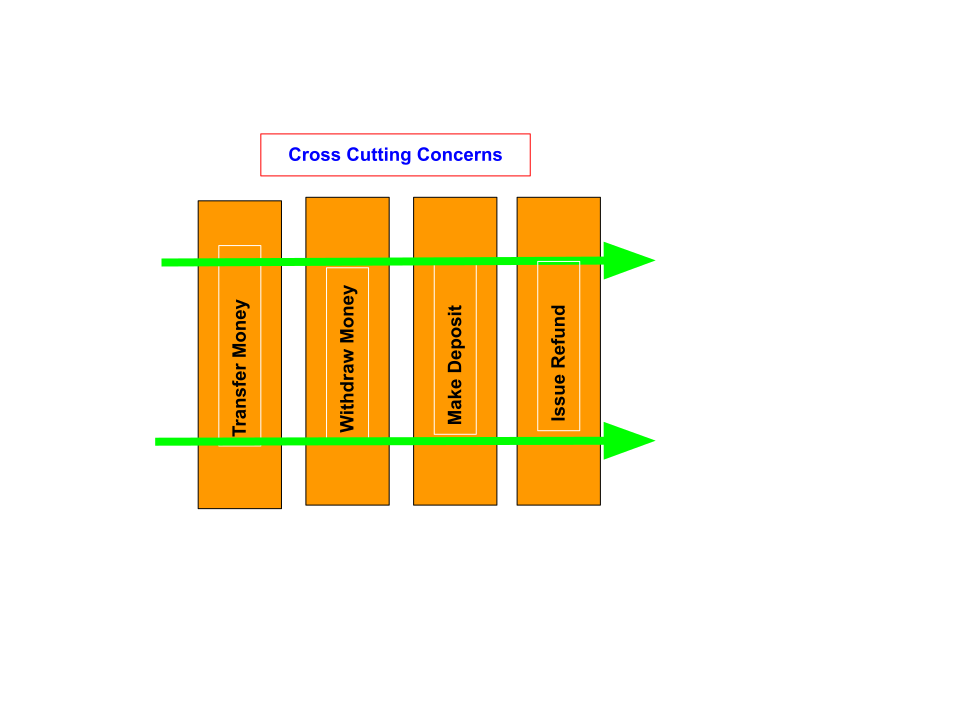
Common examples:
- Logging: We need it in your controller, service, repository, and utility classes
- Security checks: Every sensitive operation needs authorization
- Transaction management: Multiple methods need to be atomic
- Performance monitoring: We want to track execution time across the app
- Error handling: Consistent exception handling everywhere
- Caching: Multiple methods could benefit from caching
Without AOP, we’d copy-paste this code everywhere. With AOP, we write it once and apply it everywhere.
The AOP Solution
With AOP, your transfer() method becomes beautifully simple:
@Transactional
@Logged
@Secured("TRANSFER")
@Audited
public void transfer(Account from, Account to, BigDecimal amount) {
    from.debit(amount);
    to.credit(amount);
    accountRepository.save(from, to);
}
All the cross-cutting concerns are handled by AOP. Our method is now focused on what it actually does (transferring money).
The logging, security, transactions, and auditing happen automatically, behind the scenes.
Core AOP Concepts
Before we jump into coding, let’s understand some AOP concepts:
1. Aspect
An Aspect is a class that contains extra behavior you want to apply across your application. Think of it as a container for cross-cutting logic.
@Aspect
@Component
public class LoggingAspect {
    // This class contains all our logging logic
}
2. Advice
Advice is a method inside an Aspect that contains the actual cross-cutting logic. It specifies when and what to execute.
Spring gives us five types of advice:
| Advice Type | When It Runs | Use Case |
|---|---|---|
@Before | Before the method executes | Validation, security checks |
@After | After the method executes (always) | Cleanup, resource release |
@AfterReturning | After successful execution | Logging results, caching |
@AfterThrowing | After an exception is thrown | Error handling, alerting |
@Around | Wraps the entire method | Performance monitoring, transactions |
Example:
@Aspect
@Component
public class LoggingAspect {

    @Before("execution(* com.app.service.*.*(..))")
    public void logBefore(JoinPoint joinPoint) {
        System.out.println("Method called: " + joinPoint.getSignature());
    }

    @After("execution(* com.app.service.*.*(..))")
    public void logAfter(JoinPoint joinPoint) {
        System.out.println("Method finished: " + joinPoint.getSignature());
    }
}
3. Pointcut
A Pointcut is an expression that tells Spring where to apply the advice. It’s like a pattern matcher that targets specific methods or classes.
Common pointcut expressions:
// All methods in the service package
execution(* com.app.service.*.*(..))

// All methods annotated with @Transactional
@annotation(org.springframework.transaction.annotation.Transactional)

// All methods in beans named "userService"
bean(userService)

// All methods in classes implementing UserRepository
target(com.app.repository.UserRepository)
4. JoinPoint
A JoinPoint represents all possible method executions that Spring can intercept. It’s the actual moment when your advice runs.
When you have access to a JoinPoint, you can:
- Get the method name
- Get the arguments passed
- Get the target object
- Proceed with the actual method execution
@Before("execution(* com.app.service.*.*(..))")
public void logBefore(JoinPoint joinPoint) {
    String methodName = joinPoint.getSignature().getName();
    Object[] args = joinPoint.getArgs();
    System.out.println("Calling: " + methodName + " with args: " + Arrays.toString(args));
}
What’s Next?
In this introduction, we’ve covered the why and what of AOP.
In the Next Part of this series, we’ll dive into the mechanics of AOP.
For now, remember this simple formula:
AOP = Separating what your code does (business logic) from how it does it (cross-cutting concerns)
Quick Reference
| Concept | What It Is |
|---|---|
| Aspect | A class containing cross-cutting logic |
| Advice | A method in an Aspect that runs at a specific time |
| Pointcut | An expression that targets where advice should apply |
| JoinPoint | The actual moment when advice executes |
| Proxy | Spring’s wrapper around your bean that enables AOP |
Let’s explore more about Spring AOP in the next part!
 Series: Spring Boot - Aspect Oriented Programming
Part 1 of 5
Comments
Join the discussion and share your thoughts